


CASE STUDY 1
Eternal Fragrance
Designer-inspired luxury scents at real-world prices (early-stage startup)
01. Insight → 02. Strategy → 03. Creative → 04. Execution → 05. Testing & Optimization
JUNE 2024 - OCT 2024
The Problem:
-
The customer wants the designer experience without the designer price. Competitors lack the luxury bottle aesthetic.
-
Launch a performance creative strategy from zero, with no existing ad account data, against well-funded competitors.
The Opportunity:
Build a trusted brand that delivers designer-level perception without the designer price guilt.
My Role:
Creative Strategist (Brand & Performance)
Developed a full-funnel creative strategy, translating customer psychology and competitor analysis into scalable ad systems across Meta, Email Marketing, TikTok, Amazon, and Walmart.
11X
Web Traffic Growth
7.23%
Avg. CTR
2.29
Avg. ROAS
01. Insight
“Luxury is desired, but price creates guilt”
GENERATIONAL INSIGHTS
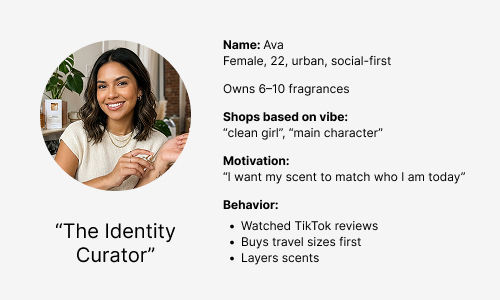
Gen Z (18-29) - "Treat Culture"
-
Digital-native, TikTok-driven discovery, does not trust mass media / brand authority
-
UGC short-form native format
-
Peer authority > Brand authority
-
-
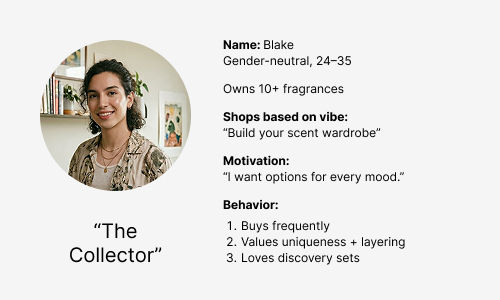
Sees fragrance as affordable confidence
-
Budget-conscious but emotionally driven
-
Buys multiple scents vs one signature
Psychology Loop: Feel stressed → buy small luxury → feel temporary relief → feel guilt → rationalize as self-care → repeat
Millennials (30-45) - "Cautious Splurger"
-
Higher disposable income, but needs validation that it's smart and high-value
-
Needs social proof & verified reviews
-
Peer authority > Brand authority
-
-
Sees fragrance as self-care + lifestyle upgrade
-
"the upgrade that actually makes sense”
-
Implications
-
Financial Stress (affordable luxury)
-
Time Stress (needs fast, punchy ads)
-
Relatability


MICRO-MOMENTS
-
Sitting on the couch at night, scrolling TikTok or Instagram. A fragrance influencer reviews a $300 niche perfume. They zoom in on the bottle, describe the scent notes, talk about compliments. The viewer saves the post, opens the brand's site, sees the price, and closes the tab.
-
At work or a social gathering, someone leans in and says "You smell really good, what is that?"
-
Browsing fragrance content on TikTok, not shopping for a specific need, but building an identity. They're curating a "fragrance wardrobe" and trying to figure out their "signature" or their rotation for different moods and occasions.
-
After buying a $200+ designer fragrance on impulse (or even a $60 bottle that doesn't perform), they're sitting with buyer's remorse. They're checking reviews post-purchase, finding negative reviews that confirm their doubt.
WHITESPACE GAPS
-
No one owns the "designer-inspired + premium design" position on Meta. Dossier uses uniform bottles to save costs. Oakcha leans into playful, trend-driven naming. ALT focuses on the price argument. Lattafa leads with cultural heritage. Nobody is saying: "This looks, feels, and smells like the $300 bottle, and it's $30." The packaging and design story is wide open.
-
No one is targeting the post-regret buyer on Meta. The person who just spent $200 on a designer and feels guilt. That's the highest-intent conversion moment in affordable fragrance.
“Customers don’t want cheap fragrance, they want to feel smart buying luxury.”
Fragrance is a shortcut to feeling like your best self, fast.
It's not about smell. It’s about identity, confidence, and social validation.
02. Strategy
1
Resolve the Guilt Loop
Reframe purchase as smart, not indulgent
2
Prove It Visually
Show, don’t claim (blind tests, comparisons)
3
Build Identity,
Not Just Product
Fragrance wardrobe
vs single purchase
4
Replace Brand Authority with Peer Trust
UGC > brand voice
03. Creative System
Full-funnel Strategy
TOF:
AWARENESS
-
Goal: Pattern interrupt + curiosity
- Scroll-stopping hooks
- UGC testimonial video
- Offer-first static
-
“They don’t want you to know this fragrance hack…”
-
"Smell like $300 for under $30..."
MOF:
CONSIDERATION
-
Goal: Reduce skepticism + build belief
- Comparison + trust
- Us vs. Them
- Testimonial
-
“No one can tell the difference”
-
“$30 fragrance… 8 hours later”
BOF:
CONVERSION
-
Goal: Push action now
-
Offer + urgency
-
Review static + promo offer
-
grid-swap
-
“Smell expensive. Pay less.”
-
“This scent keeps selling out…”
04. Execution & Testing
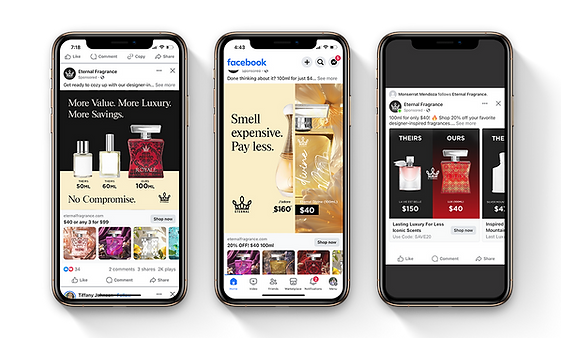
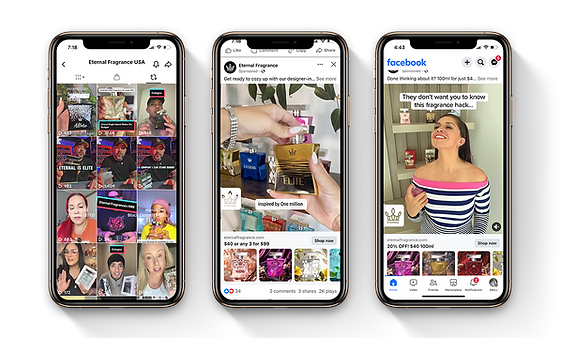
Being a new brand, we needed to build awareness and credibility. We went to market with what we knew: Us vs. Them, Social proof and demo, Luxury look differentiator. We tested 3 concepts and iterated based on Ad Spend vs. CTR. We then scaled the winners, testing different ad formats and product visuals.
Hypothesis 1: Us vs. Them / MOF
If we place Eternal Fragrance in direct visual comparison, against both luxury originals (price gap) and dupe competitors (size + quality gap), it will convert MOF evaluators who are already fragrance-aware but actively choosing between options.
Note: The Dupe comparison ad performed best
Meta: 5.05% CTR | $0.51 CPC
Hypothesis 2: Cinematic b-roll / TOF
If we lead with premium visual storytelling; bottle close-ups, texture, aspirational lifestyle; anchored by a price-shock hook, it will stop the scroll for luxury-aspiring viewers who don't yet know the brand and convert them on the identity promise.
TikTok: 5.41% CTR


Hypothesis 3: Testimonial, Unboxing, Demo / Full
If we lead with real-person testimonials that mirror organic fragrance content, the peer-trust signal will outperform brand-voice creative across all funnel stages for Gen Z and Millennial audiences.
Meta: 7.14% CTR | $0.10 CPC
Learnings & Optimization
Launching a performance-driven creative strategy from zero, without historical ad data, required building both demand generation and conversion systems simultaneously in a highly competitive, well-funded category.
1. Hero Product Focus
-
We learned what our popular products are, and focussed efforts there.
-
Narrowing to 2–3 hero products reduced overwhelm and increased trust and clarity.
-
Royale had the most social buzz but Escape and Atlas were the top performers on TikTok.
-
2. Platform-Native Creative Wins - Social Proof
-
Meta drove 11x traffic but conversion lagged. Human social proof is required to earn the conversion. TikTok influencer ads converted better.
-
Native-style showing off the bottle designs and taking about each scent's personality lowered CPC by 40%.
-
Reviews showed:
-
Emphasize beautiful bottles and no harsh chemicals.
-
Accuracy to the designer brand.
-
Include notes, what the scent smells like.
-
Blind buy/test performs well.
-
3. Our Winning Formula
-
Brand content builds awareness. Influencers close the sale. Brand content brought in interest from influencers and gave them a foundation to work from. Neither worked as well alone.
4. Customers who already buy dupes
-
Us vs. Them split-screen statics fatigued quickly
-
Priority 1: Winning ads focused on customers who already buy dupes. Iterate and exploit.
-
Instead of "Smell expensive. Pay less." → "Smells like $300 for under $30" / "Smell like BR540 for under $30".
-
Scale


